> ## Documentation Index
> Fetch the complete documentation index at: https://docs.apowerb.com/llms.txt
> Use this file to discover all available pages before exploring further.
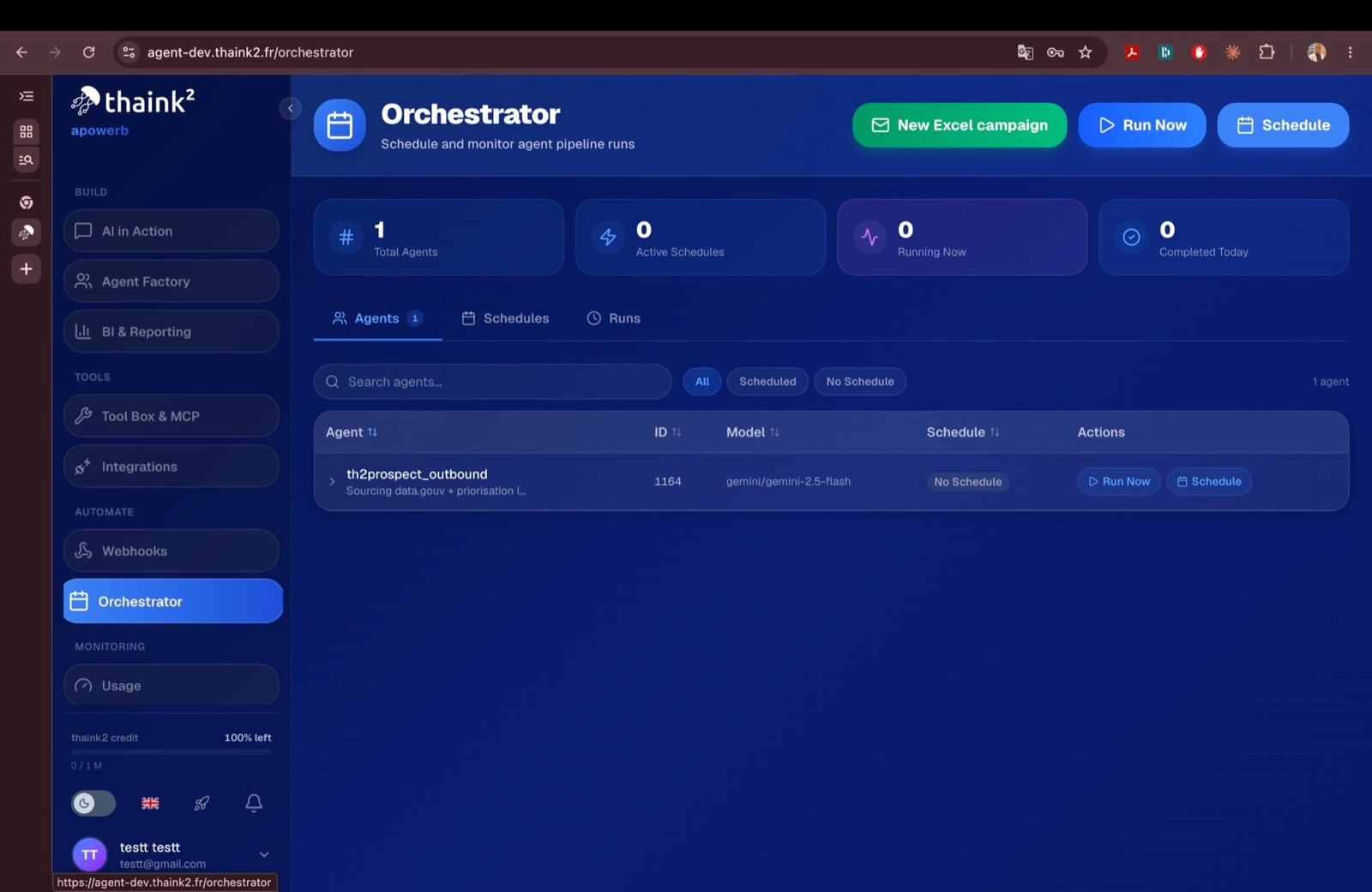
# Orchestrator
> Run agents on a cron schedule, through the orchestrator of your choice.
Recurring runs are delegated to an **orchestrator**. Two are supported, and they are
interchangeable: the client for each implements the same method surface, so nothing in
the calling code changes when you switch.
| `ORCHESTRATOR` | Backend | Notes |
| -------------- | ------------------------------- | ------------------------------------------------- |
| `mage` | [Mage AI](https://www.mage.ai/) | **the default** — used when the variable is unset |
| `th2etl` | [th2etl](/ecosystem/th2etl) | the in-house replacement |
Only these two values change behavior. Anything else is read as an unrecognized
setting and falls back to `mage` — there is no third backend.
The setting is read by the listing endpoints too, not only when a schedule is created.
A deployment that flips the flag without restarting keeps reading the previous
orchestrator, and the runs created on the new one never appear.
 ## Scheduling a run
```json theme={null}
POST /api/adk/schedule_run
{
"agent_id": "agent42",
"user_id": "user@example.com",
"session_id": "session_scheduled",
"new_message": {
"role": "user",
"parts": [{ "text": "Generate the daily report" }]
},
"schedule_interval": "@daily",
"start_time": "2026-03-10T08:00:00"
}
```
### Interval shortcuts
| Preset | Cron |
| --------------------------- | ------------------- |
| `@hourly` | `0 * * * *` |
| `@daily` — also `@midnight` | `0 0 * * *` |
| `@weekly` | `0 0 * * 0` |
| `@monthly` | `0 0 1 * *` |
| Custom | e.g. `*/15 * * * *` |
Mage accepts the `@interval` shortcuts directly. The th2etl client translates them into
five-field cron expressions before creating the trigger, so the same request body works
against either backend.
## Managing schedules and runs
| Method | Endpoint | Description |
| ------ | ------------------------------------------------------------- | ----------------------------- |
| GET | `/api/pipelines` | List pipelines |
| POST | `/api/pipelines/agents/triggers` | Create a trigger for an agent |
| GET | `/api/pipelines/{pipeline_uuid}/schedules` | List an agent's schedules |
| PUT | `/api/pipelines/{pipeline_uuid}/schedules/{schedule_id}` | Update a schedule |
| GET | `/api/pipelines/{pipeline_uuid}/schedules/{schedule_id}/runs` | List a schedule's runs |
| GET | `/api/pipelines/runs/{run_id}` | Get one run |
| GET | `/api/pipelines/runs/{run_id}/logs` | Get a run's logs |
| PUT | `/api/pipelines/runs/{run_id}/cancel` | Cancel a run |
The endpoints keep the `pipelines` naming from the Mage era. They are orchestrator
agnostic: the same calls reach th2etl when the flag is set.
## What changes between the two
The mapping matters if you inspect the orchestrator directly rather than through this
API.
| | Mage | th2etl |
| --------------------- | ------------------ | ------------------------------------------------------------------------ |
| Unit per agent | a pipeline trigger | one scheduler, **named after the `agent_id`** |
| Schedule identifier | an integer id | the scheduler **name** |
| Per-trigger variables | trigger variables | the scheduler's `variables`, injected into the run context on every fire |
| Ad-hoc trigger | trigger a run | `POST /schedulers/{name}/run` |
Identifiers are opaque to callers — read one from a listing and pass it back. Do not
compare them numerically: Mage ids are integers while th2etl uses names, and a
numeric comparison against a th2etl id silently fails to match.
## Configuration
See [Configuration](/configuration) for the variables each orchestrator needs. When
`ORCHESTRATOR` is unset, the server talks to Mage — so a deployment that means to use
th2etl must set it explicitly.
## Scheduling a run
```json theme={null}
POST /api/adk/schedule_run
{
"agent_id": "agent42",
"user_id": "user@example.com",
"session_id": "session_scheduled",
"new_message": {
"role": "user",
"parts": [{ "text": "Generate the daily report" }]
},
"schedule_interval": "@daily",
"start_time": "2026-03-10T08:00:00"
}
```
### Interval shortcuts
| Preset | Cron |
| --------------------------- | ------------------- |
| `@hourly` | `0 * * * *` |
| `@daily` — also `@midnight` | `0 0 * * *` |
| `@weekly` | `0 0 * * 0` |
| `@monthly` | `0 0 1 * *` |
| Custom | e.g. `*/15 * * * *` |
Mage accepts the `@interval` shortcuts directly. The th2etl client translates them into
five-field cron expressions before creating the trigger, so the same request body works
against either backend.
## Managing schedules and runs
| Method | Endpoint | Description |
| ------ | ------------------------------------------------------------- | ----------------------------- |
| GET | `/api/pipelines` | List pipelines |
| POST | `/api/pipelines/agents/triggers` | Create a trigger for an agent |
| GET | `/api/pipelines/{pipeline_uuid}/schedules` | List an agent's schedules |
| PUT | `/api/pipelines/{pipeline_uuid}/schedules/{schedule_id}` | Update a schedule |
| GET | `/api/pipelines/{pipeline_uuid}/schedules/{schedule_id}/runs` | List a schedule's runs |
| GET | `/api/pipelines/runs/{run_id}` | Get one run |
| GET | `/api/pipelines/runs/{run_id}/logs` | Get a run's logs |
| PUT | `/api/pipelines/runs/{run_id}/cancel` | Cancel a run |
The endpoints keep the `pipelines` naming from the Mage era. They are orchestrator
agnostic: the same calls reach th2etl when the flag is set.
## What changes between the two
The mapping matters if you inspect the orchestrator directly rather than through this
API.
| | Mage | th2etl |
| --------------------- | ------------------ | ------------------------------------------------------------------------ |
| Unit per agent | a pipeline trigger | one scheduler, **named after the `agent_id`** |
| Schedule identifier | an integer id | the scheduler **name** |
| Per-trigger variables | trigger variables | the scheduler's `variables`, injected into the run context on every fire |
| Ad-hoc trigger | trigger a run | `POST /schedulers/{name}/run` |
Identifiers are opaque to callers — read one from a listing and pass it back. Do not
compare them numerically: Mage ids are integers while th2etl uses names, and a
numeric comparison against a th2etl id silently fails to match.
## Configuration
See [Configuration](/configuration) for the variables each orchestrator needs. When
`ORCHESTRATOR` is unset, the server talks to Mage — so a deployment that means to use
th2etl must set it explicitly.